Saturday, February 7, 2015

A Box of Chocolates in Black and White

It's not as serious as it looks.
Relationships in the 21st Century are complex, and they say love is elusive. But in the romantic comedies of the 1930s and '40s, things were a little simpler. And funnier. (And not so serious.)

These films were a platform for boy-meets-girl or society-dame-vs.-regular-guy plots that invariably included one or both parties being at odds with each other at first, but ending up in the clinch after a series of pratfalls, embarrassing moments, and screwball situations that poked holes in the conventions of the times.

Not to put too fine a point on it, but I'm just in time for Valentine’s Day with this latest post. Let's say I’ve pulled together a little box of chocolates that represent seven of these films, just a mere fraction of the many delightful romantic comedies made during the period. Some are bonafide classics, others are lesser-known, but they are all worthwhile for their terrific performances, memorable situations, clever dialogue, and optimistic tone.
Clark and Claudette
thumb for a ride.

“It Happened One Night” (1934)
Claudette Colbert is a spoiled rich girl who’s running away from an arranged marriage. Clark Gable is the skeptical, hard-nosed reporter forced by his editor to cover her story. At first they can’t stand each other, but during a cross-country bus trip full of funny complications, they fall in love. This enchanting film was the first to sweep the Oscars, winning Best Picture, Actor, Actress and screenplay.

“Bringing Up Baby” (1938)
My all-time favorite movie gets funnier every time I see it. Cary Grant plays an absent-minded paleontologist in search of a missing dinosaur bone. Katharine Hepburn is the free-wheeling, fast-talking heiress who, along with her feisty wire-haired terrier and docile pet leopard, practically ruins Grant’s plans to acquire $1 million from her wealthy aunt. This screwball comedy, full of nutty characters, moves at breakneck pace with one anarchically hilarious scene after another.


Fred and Madeleine
being beautiful together.
“Honeymoon in Bali” (1939)
Boy meets girl in this romantic comedy, in which Fred MacMurray chases single mom Madeleine Carroll, with hot competition coming from a snobby aristocrat. MacMurray and Carroll make a captivating team in this sweet-natured and leisurely-paced little movie. Made in a year that generated some of Hollywood’s biggest classics, it has been unjustly overlooked.

“The Philadelphia Story” (1940) 
Spoiled high society girl Katharine Hepburn is preparing to get married again when her ex-husband (Cary Grant) pops up. Meanwhile, an inquisitive tabloid reporter (James Stewart) arrives with his photographer girlfriend (Ruth Hussey) to cover the upper-crust wedding and becomes infatuated with the bride-to-be, causing consternation from the groom-to-be (John Howard). More sophisticated than some screwball farces of the time, this film glimmers with wit and reminds me of a fast-forwarded Jane Austen comedy of manners. (Although maybe that would be an insult to Philip Barry, the man who wrote the play on which the film is based.) The three stars, who are all great, get fun support from Roland Young as randy Uncle Willie and Virginia Weidler as Kate’s precocious little sister Dinah.

Carole and Bob's sexual chemistry
was quite fun to watch.
“Mr. and Mrs. Smith” (1941)
When Robert Montgomery and Carole Lombard find out that their marriage isn’t legal, they decide to try life without each other. But because they’re still in love, they do everything they can to sabotage each other’s attempts to meet new people. This chic comedy was directed by none other than Alfred Hitchcock; but while he demonstrates a light touch throughout, there is definitely a dark undertone to the story that's accentuated by the rich cinematography. The film co-stars Gene Raymond and the always fun Jack Carson. (Side note: Montgomery was the father Elizabeth Montgomery of “Bewitched” fame.)

Jimmy and Bette together again.
“The Bride Came C.O.D.” (1941)
Bette Davis wasn’t known for her comedic abilities, but in this fast-paced romp, she stars as a spoiled girl hijacked to a deserted Death Valley ghost town by down-to-earth pilot James Cagney. He knocks her down a few pegs, and deservedly so. In the process, she decided she likes him better than the pompous band leader to whom she’s engaged. It’s not a great movie, and echoes "It Happened One Night," but it's still fun to see Davis in a harmless bit of romantic whimsy. As stalwart Warner Bros. contract players, she and Cagney had dynamite chemistry.

“The More the Merrier” (1943)
It's wartime in Washington, DC, so a government worker (Jean Arthur) agrees to rent out part of her apartment to a retiree (Charles Coburn). She’s extremely organized, and insists on keeping a tight schedule so they’ll stay out of each other’s way. But complications ensue when the old guy invites a highly attractive sergeant (Joel McCrea) to also stay rent the cramped apartment. At first she's outraged by his presence, but it doesn’t take long for sparks to fly. The scene on the front steps between McCrea and Arthur may be one of the most subtly, comically sexy ever committed to film.

Even if you’re not a fan of Valentine’s Day (I’m not), you can still get a kick out of a few films that do two things that Hollywood in the 1930s and early '40s did very well: romance (however idealized) and comedy (sophisticated, low brow, or a combination of the two). Get a taste of kisses and pratfalls and enjoy.

Wednesday, January 28, 2015

Luise Rainer: The Great, the Good, and the Gone

Luise Rainer in Hollywood
In the 1930s, Greta Garbo was the apotheosis of glamour and beauty. The Swedish movie star had a languidness, allure, and mystery that audiences at the time found irresistible. And because Hollywood knows how to imitate past success (or at least try), it’s no surprise that studios of the era searched Europe for “The Next Garbo.”

So from Italy came Elissa Landi; from France, Annabella; from Russia, Anna Sten. The studios tried their hardest to herald these and other women as “The Next Garbo.” (Even Katharine Hepburn was billed as “The American Garbo” when she hit the Hollywood scene in 1932.)

Almost none of these European imports made much of an impact on audiences, or if they did, it was short-lived. Their careers evaporated by the end of the decade.

But of all those Garbo imitations, Luise Rainer, an import from Austria, was perhaps the most interesting flame-out ever.

I write about her in this blog post because she passed away on December 31st at the ripe old age of 104, one of the last links to Hollywood’s “Golden Age” of the 1930s. (The only other survivor that comes to mind is Olivia de Havilland, who will be 100 next year.)

She was brought to MGM to make the film “Escapade” in 1935. Co-starring the hugely popular William Powell, Rainer was a sensation; she had a freshness and vitality that was distinctly her own. She was much more alive on screen than Garbo ever was, and the studio played up her big, expressive eyes and charming personality.

Rainer accepts her first Oscar,
trademark tousled hair and all.
She had talent, too, so with the success of “Escapade,” she could only go up. Her next feature was “The Great Ziegfeld” in 1936, again opposite Powell. The film concerned the dramatic life of 1900s theatrical producer Florenz Ziegfeld. Rainer was cast as his first wife, the stage star Anna Held.

The studio promoted Rainer massively, and she won an Oscar for Best Actress for her performance. This prestige got her cast in MGM's biggest epic ever the following year.

In the studio's big-budget adaptation of Pearl S. Buck’s novel “The Good Earth,” about Chinese peasants, Rainer brought a quiet sensitivity and dignity to her characterization as O-Lan, the long-suffering wife. To modern audiences, it may seem strange that an Austrian woman would be cast as a Chinese peasant, but in the 1930s and 1940s, it was not unusual for white actors to be cast as Asians. (Think of Charlie Chan.) The modern perspective notwithstanding, Rainer was brilliant, and won the Oscar for Best Actress, her second in a row.

But Hollywood and its incessant promotion didn’t suit her. Subsequent film roles didn’t require her to do much, and the films were consistently mediocre, despite being cast opposite such big names as Spencer Tracy and Melvyn Douglas (and one more time with William Powell). She constantly clashed with MGM’s head Louis B. Mayer, which probably didn’t do her career any favors.

It’s sort of movie lore that Oscar winners’ careers sometimes veer tragically off-course (unless you’re Meryl Streep). But Luise Rainer is probably the text book version of that theory.

By 1938, Rainer had had enough of Hollywood, and my guess is that MGM had had enough of her. She walked away, and a white-hot career was over within three years.

She even looked a little like Meryl Streep.
Unhappily married to the playwright Clifford Odets, she tried to make a comeback in 1943, playing in the B-grade war film “Hostages” at a different studio. But it wasn’t enough; the film was not good or successful, and no one seemed to care that she was back after a five-year hiatus.

Plus, things had changed too much. America was at war, and the war had effectively put an end to the exotic European female aesthetic in Hollywood. (Indeed, Garbo saw the writing on the wall and retired in 1941.) Europe became not so much the source of beautiful women, but of international strife. Audiences wanted more relatable American types, like Ginger Rogers, Donna Reed, or June Allyson.

“Hostages” was Rainer’s last mainstream Hollywood film. But she still must have had a desire to go before a camera, for she made sporadic television appearances from 1949 to 1954 on such early product-sponsored live television broadcasts as Lux Video Theatre and Schlitz Playhouse. After that, she had exactly three TV roles: In 1965 on “Combat!”; in 1984 on “The Love Boat”; and in 1991 on a Swiss television series.

But nothing on film, until she took a small part as The Grandmother in an obscure British film called “The Gambler” in 1997—at age 86. (One wonders if Gloria Stuart’s return to the screen that year in “Titanic,” playing the 87-year-old Rose, had any influence on Rainer’s desire to come back to the big screen after 54 years.)

Luise Rainer is not a name that many people recognize today. But she is significant for being the first actor to win the Best Actress Oscar two years in a row. She is also the greatest case of a career implosion from that era—someone who got the huge Hollywood build-up but couldn’t handle the Hollywood way, and eventually left it all behind.

Kudos to Rainer for living to such a ripe old age, and seemingly doing so with grace and style. For fans of classic film, she possessed a mystique as one of the last surviving vestiges of the Golden Age of Hollywood, a time that is quickly being consigned to history rather than the memory of those who lived it.

Monday, December 8, 2014

Getting in the Mood for Christmas

There is simply a special feeling created by black-and-white Christmas movies. I’m not sure if it’s the nostalgic look or the soothing tone of these films, but they definitely get you in a certain mood.

For this month's blog post, I’ve chosen four titles that aren’t particularly well-known but are worth a look, not just for their holiday spirit, but because of the quality of the production, the performances of their stars, memorable comic moments, or just their sheer watchability.

They span the decade between 1939 and 1949. The first two were made before the United States got into a world war, so they’re rooted in that pre-war period when the country was coming out of an economic depression. The third was made in the middle of the decade and the last year of the war; a war veteran figures prominently. The fourth was made in the last year of the 1940s, and it has a different tone; its main character is a war widow, and the picture’s mood is a little more sedate.

What they all have in common is a light touch that will add warmth to your holiday movie watching.

"Bachelor Mother" (1939) – As a salesgirl at Merlin and Son department store, Polly Parrish (Ginger Rogers) has a lot going for her. She’s got a good job, she’s cute as a button, and she's generally enjoying life as a single gal. 

Until she finds out that, after Christmas, she’s going to lose her job. Not a great thing to happen during the Great Depression.

Dejected, she takes a lunch break and sees a desperate-looking woman leaving a baby on the steps of an orphanage. Before Polly can get to her, the woman is gone. Polly stoops to make sure the baby won’t roll down the steps, but when the orphanage door opens, the proprietor automatically assumes that Polly is the baby’s mother.

Polly can’t seem to talk her way out of the situation, so she reluctantly assumes care of the baby in her small apartment.

Meanwhile, the “Son” in Merlin and Son, David Merlin (David Niven), learns of her situation and takes pity on this 'unwed mother.' He secures her old job and even helps out with the baby. It's around this time that David's father (Charles Coburn) assumes that David is the father. While he's not happy with the situation as he sees it, he rather likes the idea of being a grandpa.

Ginger Rogers pretends to be Swedish.
Of course, after a rather acrimonious start, David and Polly begin to fall for each other. Two scenes stand out in particular: The New Year's party at a raucous night club, where David brings Polly as his guest—and tells the others at their crowded table that she is Swedish and “doesn’t speak a word of English.” (Rogers basically makes up her own language, and it’s a riot.) The follow-on scene, when David and Polly kiss amidst the noise of dozens of revelers in Times Square is handled in a skillful and unusual way by director Garson Kanin; it’s splendidly underplayed by Rogers, as the reluctant and put-upon Polly, and Niven, as the dashing and impetuous David.

The film is a conventional comedy-romance, but it’s also a special holiday treat. From the studio back lot snowfall, the charming tinseled trees and decorations, and the nostalgic toys in the store (note the Donald Duck product placement for Disney), this is a warm evocation of Christmas and the big city in the 1930s. While it’s part of the past, it’s still a relatable story.

"Remember the Night" (1940) – Lee Leander (Barbara Stanwyck) ambles down a crowded street at Christmastime and jauntily walks into a jewelry shop. She's a shoplifter, and she snags a handsome bracelet. But Lee doesn't get too far, the cops are on her, and the next thing she knows, she’s in jail.

Assistant D.A. John Sargeant (Fred MacMurray) is assigned to prosecute her, and the trial is set to begin just before Christmas. John takes pity on Lee and gets the trial postponed, posting her bail so she won’t spend the holiday in a cell block. Lee is grateful, but with reservations; she's simply not used to kindness.

As he gets ready to drive to his mother’s farmhouse in Indiana, John learns that Lee is going the same direction, so he offers to give her a lift to her mother’s home. But during the trip, they inadvertently crash through a fence and get stuck in a seemingly remote Pennsylvania field. In the morning, the landowner arrests them for trespassing and hauls them off to a justice of the peace by gunpoint. While the justice prepares to arrest them, Lee starts a fire in a garbage can to create a distraction, grabbing John and fleeing in his car.

Shaken by what’s happened, they eventually arrive at the rundown house where Lee’s mother lives. John sees for himself that Lee's wayward life may be connected to the fact that her mother is a mean, bitter woman who shows her no affection.

Taking pity again, John offers to take Lee to his mother’s home as his guest. When they arrive, John’s mother (Beulah Bondi) warmly greets them both.

Christmas with the old folks at home.
The sweetest scene of the film occurs at this point, when everyone exchanges Christmas gifts in the cozy living room. John tells Lee about his childhood, and she remarks on photos of him as a boy and college student. Lee realizes that there really are people who have close and loving relationships, who aren’t just out for themselves. In this quiet, understated scene, we realize that Lee is falling in love with John.

John tells his mother about Lee's past, so his mother finds the right moment to take Lee aside to encourage her to do the right thing; John has worked so hard to become Assistant D.A., and nothing should throw him off course.

On the way back to New York, John and Lee go through Canada in order to avoid the possibility of arrest in Pennsylvania. Stopping at Niagara Falls, he offers her the chance to flee on her own, but she doesn’t take him up on it—which means she’ll go back to New York and face a jury after all. You can watch to see for yourself what happens.

This is a simple story that takes its time to create a special mood, especially once John and Lee arrive at his mother’s home. Stanwyck is typically gritty but sympathetic as Lee; MacMurray is affable as always, but seems like a guy who wants to do the right thing without being a sucker. Beulah Bondi made a career out of playing warm-hearted mothers; you may know her as James Stewart’s mom in “It’s a Wonderful Life,” and she's hard not to love. 

Side note: Astute listeners will recognize Sterling Holloway, as John’s goofy cousin Willie, as the future voice of Winnie the Pooh.

"Christmas in Connecticut" (1945) – Typical of the lightweight, corny comedies that Warner Brothers turned out during WWII, there is somehow something special about "Christmas in Connecticut." Maybe it's due to the effortless performances of it stars and its bright, cozy production design, which evokes a particular time and season in such an appealing way.

Elizabeth Lane (Barbara Stanwyck) is a popular columnist for a women’s magazine. She writes about food and her lovely home in Connecticut with her husband and baby. Her readership adores her. (Think Martha Stewart before jail.)

The problem for Elizabeth is that she lives in an apartment in New York City, is single, has no baby, and doesn’t know how to cook. The magazine’s publisher (Sydney Greenstreet) is unaware of any of this, and insists that she host a special dinner for a war hero on Christmas Eve as a publicity stunt.

How can she say no? And how can she find a Connecticut farmhouse, a husband, and a baby in time? (Not to mention learn to cook?)

First she secures the quaint Connecticut farmhouse of her friend John (Reginald Gardiner). Then she plans to marry John to get an instant husband. (They can divorce later.) And to prove she can cook, she’ll get help from the chef (S.Z. Sakall) who’s been the source of her “custom” recipes all along.

When war veteran Jefferson Jones (Dennis Morgan) arrives at the farmhouse, the charade is off to a fairly good start, until Elizabeth has to bathe the baby. She has actually never bathed one before, but before the truth comes out, Jefferson takes over and proves he has a way with children.

She can't cook, but maybe she'll have luck
with flipping her flapjacks.
It’s about this time that Elizabeth gets smitten. Complications of the plot include a baby mix-up, a swallowed wristwatch, a night in jail, a befuddled judge, a cantankerous cook, and the whole charade eventually coming apart.

The story is easy to take, its mistaken identities and contrived circumstances buoyed along by the fine playing of its stock cast, who all seem to be having a good time. Part of the appeal of the film is how atmospheric it is. Most of the action takes place in the farmhouse, and the sets are roomy and comfortable, capturing the brightness of big windows catching the light of a perfect snowfall. It’s a place that Martha Stewart would be happy with—even if it’s all on a studio backlot.

"Holiday Affair" (1949) – This is one of the best classic Christmas movies you’ve probably never heard of. And since other titles in the classic Christmas canon, such as “Miracle on 34th Street” and “It’s a Wonderful Life,” have been overplayed for years, maybe it’s a good thing.

Here we have Connie (a very young Janet Leigh), who is a covert comparison shopper for a department store. While spying in Crowley’s, a rival store, she buys a toy train to examine.

While on her train-buying mission, she’s found out by a Crowley’s clerk named Steve (Robert Mitchum). But rather than revealing her to management, he lets her go—which gets him fired.

Connie feels sorry for him and invites him for Christmas dinner with her son Timmy (Gordon Gebert) and stuffy fiancé Carl (Wendell Corey).

When Steve learns that Timmy thinks the train—which was hidden in Connie’s bedroom—is his Christmas gift, Steve decides to buy it for him, knowing that Connie can’t afford it. (She was planning on returning it.)

Comparison shopping never looked
so good.
When Connie discovers that Steve bought the train, she is upset, knowing that he’s out of work and can't afford it himself. And when Timmy realizes the train was not intended for him, he feels that he’s caused a big problem, so decides to return it to Crowley's himself.

Meanwhile, Steve has fallen for Connie, and makes his feelings known to Carl, who is none too pleased. Connie is ambivalent about Carl, yet racked with guilt about her burgeoning feelings for Steve. She’s a single mother and a war widow who just wants the best for Timmy (who wants Steve for his step-father).

The movie really is just about the complications that ensue among four people and a train set. But perhaps it’s the simplicity of the story, the clever and solid screenplay, and the effortlessly smooth work from its stars (especially Leigh and Mitchum) that make it work so well. It's a nostalgic heart-warmer that avoids overt sentimentality while capturing the tone and spirit of a post-war America.

While these four movies are not works of great cinematic art, they stand as undiscovered Christmastime gems and fine examples of crowd-pleasing entertainment of the Hollywood studio era, perfect for viewing at this special time of year.

Happy holidays from In a Movie Place!

Tuesday, November 18, 2014

Thanks For Your Support

I was talking movies with my friend Amir the other day, and the name Celeste Holm came up. We both agreed that she had a unique personality, and she featured prominently in some true classics, including a film that tackled the then-taboo subject of anti-Semitism. Never the star of the picture, Holm nevertheless made an impression in a number of other supporting parts in several notable films of the post-war years.

Thinking of her solid support led me to writing this post. I gave some thought to the many, many supporting players during Hollywood’s Golden Age, who were usually cast in second lead roles. It was hard, but I narrowed it down to four very different people—two men and two women—who, to my eye, always elevated the material by their sheer presence, personality, and professionalism.

Let’s start with Miss Holm, and go from there.

Celeste Holm
After making a splash in the original Broadway production of “Oklahoma!” Hollywood beckoned Holm, a new talent who brought a refreshing naturalness to the screen and enhanced a number of high-profile pictures in the late 1940s and early 1950s. She is a distinctly post-war figure in films.

Like many of the women who came before her, she could do comedy as well as drama. In each role she played, though, her wit is prevalent. With Celeste Holm, you always got a strong and smart, yet feminine and refined, woman who was quick with a well-delivered barb. Here are a few of her best films:

“Gentleman's Agreement” (1947) – Gregory Peck plays Philip Green, a writer who is pretending to be Jewish to reveal anti-Semitism in America. He learns how prevalent it is and finds it, along with hypocrisy, in surprising places. After appearing in a couple musicals that leveraged her singing ability and comic ability, “Gentleman’s Agreement” gave Holm an opportunity to show off her subtle dramatic chops; she lends strong support as Philip’s friend Anne (who may or may not be in love with him). Her character is a stylish, warm-hearted sophisticate who is the moral center of the film. It co-stars John Garfield, Dorothy Maguire, and the marvelous Anne Revere as Peck’s mother.

“A Letter to Three Wives” (1948) – Holm is the narrator of this film, a wry satire on post-war suburban mores. As the unseen Addie Ross, the film unfolds as Holm reads the letter that Addie has sent to her three dearest friends. In it, she explains that she has left town with one of their husbands. The balance of the movie focuses on the stories of the three women (Jeanne Crain, Linda Darnell, and Ann Sothern) and the relationships with their husbands (Jeffrey Lynn, Paul Douglas, and Kirk Douglas, respectively). Who’s hubby did Addie steal? You’ll have to watch to find out. It’s a smart film, and Holm sets the tone at the outset with her dry, droll, cunning narration.

“Come to the Stable” (1949) – In a change of pace, Holm and Loretta Young play French nuns who come to a small New England town to build a children's hospital. They are surprised to find that some of the townsfolk are against their plan—including representatives of the Catholic church. It’s a very sweet and gentle film, and Holm is suitably tender in it, demonstrating that she did not always have to be the brittle, witty sophisticate. That said, she does have a funny scene where she plays a mean game of tennis—and aims to win.

"All About Eve” (1950) – In perhaps her best-known film and role, Holm is Karen Richards, the best friend of Bette Davis’s Margot Channing, a famous, temperamental stage star. Where Davis’s performance is florid and funny, Holm’s Karen is more sedate; she’s the serene leveler to Margot’s self-indulgence, the calm in the midst of a stormy story that’s full of larger-than-life theater types. Everyone gets to chew the scenery at one point or another, including Anne Baxter, George Sanders, Gary Merrill (later Davis’s husband), and even Marilyn Monroe in an early role. Not to be missed.

After 1950, Holm spent most of her career in the new medium of television, including her own sitcom. She made sporadic film appearances, including a few musicals that took advantage of her excellent voice, all the way up to 2012, when she died at age 96.

Jack Carson
Jack Carson is a type of man you just don’t see anymore. More often than not, he played an affable, back-slapping type. He was a guy’s guy with a self-deprecating laugh and a comically skeptical sidelong glance to punctuate a line, whether his or someone else’s.

Small parts in nearly 50 A- and B-grade films from 1937 through the early ‘40s had him in lots of small or unbilled blue collar roles as cab drivers, truck drivers, and cops, with occasional bigger parts that revealed his comic timing. He lent light support in comedies starring such big names as Bette Davis, James Cagney, Ginger Rogers, Edward G. Robinson, Carole Lombard, and others. 

After WWII, he landed at Warner Brothers, where he became one of their most dependable players. Although not all from Warners, here are a few of his notable titles:

“Love Crazy” (1941) – This is one of my favorite comedies, in which William Powell pretends to be insane so he can get back into his wife’s (Myrna Loy) good graces. The movie is fast-paced slapstick, and has some very funny moments. It’s one of the many early roles that stereotyped Carson as a guileless dunderhead. Here, he’s Loy’s neighbor (“The name’s Willoughby, Ward Willoughby”) who has designs on her even as Powell tries to make amends. Carson’s patented double-takes and quizzical looks make every scene he’s in a riot.

“The Hard Way” (1943) – Helen Chernin (Ida Lupino) pushes her younger sister Katherine (Joan Leslie) into show business as a way of getting out of their dingy steel town. As part of that plan, she urges Katharine to marry Albert Runkel (Carson), an old-school Vaudevillian who’s down on his luck. Katharine eventually becomes a Broadway star, but Helen’s conniving takes its toll on everyone, especially herself. This is prime grade-A Warner Brothers melodrama, and Carson gets a chance to add some shading to his shabby song-and-dance man.

Carson made three movies with Doris Day
and 11 with Dennis Morgan (at right).
“Mildred Pierce” (1945) – In this classic film noir, Joan Crawford is the show as a poor woman who becomes a successful restaurateur, all the while trying to keep her spoiled daughter (Ann Blyth) from ruining both their lives. As Wally Fay, Carson is a would-be real estate mogul who nurses an ongoing crush on her. He leverages his established persona as a cuddly bear, but while he's amusingly lecherous, he makes his character heartfelt as well, the kind of guy a hard-working gal needs as a friend. Carson also gets some terrific dialogue, especially his banter with Eve Arden (who deserves her own blog post).

“Cat on a Hot Tin Roof” (1958) – By the late ‘50s, Hollywood had changed, as had filmgoers’ tastes. Now Carson could turn his affable-guy persona into someone less than sympathetic. In this somewhat watered-down film adaptation of the play by Tennessee Williams, Carson is Gooper Pollitt, the scheming older brother of the tortured Brick (Paul Newman). Carson’s is an excellent performance in a stellar ensemble that also includes Elizabeth Taylor, Burl Ives, Judith Anderson, and the venal Madeleine Sherwood. Carson’s work here is worth seeing as a counterpoint to his persona of the previous decade.

During his heyday of the mid-to-late 1940s, audiences preferred Jack Carson in light fare, and he always delivered. While most of the many comedies and musicals he made after WWII are forgotten today, he kept busy all the way up to 1963, when he succumbed to cancer. By then, most of his male contemporaries—Bogart, Gable, Cooper, and many others—were already gone, thus confirming that the Golden Age of Hollywood was over.

Mary Astor
Mary Astor started out as a leading lady in silent films and successfully made the transition to talking pictures. Throughout the 1930s, she played mostly high society ladies in sophisticated parlor comedies, romances, and even an adventure film or two. But she really came into her own in the 1940s by playing a range of fascinating characters that were quite distinct.

Astor could be sweet or sour, or sometimes both. She could be tender and pathetic, arch and austere, haughty or heroic, hilarious or nefarious. In fact, her most famous role was Brigid O’Shaughnessy, the film noir femme fatale archetype, in 1941’s “The Maltese Falcon.” But just three years later, there she was being Judy Garland’s understanding mother in “Meet Me in Saint Louis.”

Whether playing a villainous vixen or a Midwestern mother, she did it all with subtle shading. Where, for example, Jack Carson delivered a reliable sameness, Astor's work varied remarkably, especially from the mid-1930s to the late 1940s. Here are a few of the titles in a long film career that stand out:

“Dodsworth” (1936) – This film was the subject of my first blog post at “In a Movie Place.” It’s a great movie, a potent slice of the American character of the mid-1930s. While Walter Huston, as rich industrialist Sam Dodsworth, is the film’s namesake, I think the heart of the movie belongs to Astor. As Edith Cortright, a slightly jaded divorcee who falls for the unhappily married Sam, she is the grounded one among a cast of characters whose heads are in the clouds. Her natural and affecting performance feels real, especially when compared to Ruth Chatterton, who, as Dodsworth’s pretentious, philandering wife, is comparatively tinny and artificial. Astor owns the heartbreaking finale.

“The Great Lie” (1941) – Five years after her sympathetic portrayal in “Dodsworth,” Astor turns the bitch factor up 100 notches as a temperamental, selfish concert pianist who gets pregnant by a married man and has to flee to the desert to have the baby in seclusion. (Only in a movie from the 1940s would this be the case.) Despite its absurdity, the film is grandly entertaining; Astor manages to steals the show from, of all people, Bette Davis, who graciously underplays, leaving the histrionics to Astor.

“The Palm Beach Story” (1942) – Just when her career seemed to be tilting to the heavy, what with all the drama and film noir treachery, Astor lightens up considerably in this hilarious comedy. She’s Princess Centimillia, the flighty, flirty sister of zillionaire J.D. Hackensacker III (Rudy Vallee), who’s after Gerry Jeffers (Claudette Colbert), who’s being chased by her husband Tom (Joel McCrae), on whom the Princess has set her eyes. Everyone in this fast-paced movie is funny, but as a clueless society dame, Astor shows a deliciously unbridled side.

“Act of Violence” (1949) – Toward the end of the ‘40s, Astor’s career was on the wane. But in the same year she played the sweet Marmee in MGM’s adaptation of “Little Women,” she played a small but pivotal role as a hard-luck prostitute in this relatively unknown but outstanding film noir. In it, she comes to the aid of Frank Enley (Van Heflin), a war veteran whose small town life with his unassuming wife (Janet Leigh) is disrupted when Joe Parkson (Robert Ryan), a soldier in Frank’s regiment during the war, comes back to get revenge. Astor’s character, known only as Pat, is pathetic and delusional, but she imbues her with a touching dignity that ends up being the thing you remember most about the film.

Like many of her contemporaries, Astor spent the 1950s and early ‘60s in television, with the occasional small movie role. She had a single, but important, scene in her last film, 1964's “Hush, Hush Sweet Charlotte” (which re-teamed her with Bette Davis, although they have no scenes together). After an eventful private life that included a sex scandal, three divorces, the death of her first husband by plane crash, alcoholism, heart problems, and more, she died in 1987 at age 81.

This quote from Astor humorously indicates that she knew full-well the trajectory of her career: “There are five stages in the life of an actor: Who's Mary Astor? Get me Mary Astor. Get me a Mary Astor type. Get me a young Mary Astor. Who's Mary Astor?"

Melvyn Douglas
Melvyn Douglas could not be more different than Jack Carson, in build, looks, style, or temperament; but like Carson, you knew what you were getting when he appeared in a film. During the 1930s and ‘40s, Douglas was always the urbane gentleman. His was a popular archetype at that time, accented by the pencil-thin mustache shared by many of his contemporaries (think William Powell, Ronald Colman, John Barrymore, Adolphe Menjou, etc.)

Looking back on his career, Douglas appeared in many genuinely unimportant movies, studio fare typical of the time. The studios leveraged his good looks but usually demanded little from him. He did get the occasional change of pace with two classic comedies that stand out: “Theodora Goes Wild” (1936) and “Ninotchka” (1939), unique in that they also gave his co-stars, Irene Dunne and Greta Garbo, the chance to loosen up and be funny for a change.

What's most interesting about Douglas is that his work during the studio era actually led up to his greatest roles in the 1960s. Here are a few key roles in his career, spanning 30 years:

“A Woman's Face” (1941) – Although you might dismiss this movie as standard soapy MGM fare, it’s actually quite well-made and includes one of Joan Crawford’s best performances. She plays Anna Holm, a criminal with a horribly disfigured face (and a really bad attitude). When Dr. Gustaf Segert (Douglas) operates to fix her disfigurement, she must choose whether to continue her life of crime or to turn over a new leaf. I include this movie here because it’s one of the better films in which Douglas appeared at this time. He acquits himself convincingly opposite Joan. (Side note: The same year, Douglas starred in another “face” movie, “Two-Faced Woman”; it was "Ninotchka" co-star Greta Garbo’s last movie.)

“Mr. Blandings Builds His Dream House” (1948) – This cute, homey little comedy could only have been made in the years after WWII. It concerns Jim and Muriel Blandings (Cary Grant and Myrna Loy), a city couple who buy a fixer-upper in the country and are presented with one calamity after another. (Kind of like Tom Hanks and Shelley Long in “The Money Pit,” but better.) Douglas is their avuncular friend Bill Cole, who wryly observes (and narrates) the zany goings-on as the Blandings try to find suburban bliss. This film demonstrates Douglas’s pivot into character parts, which would define the remainder of his career.

Again, it seems that the first two decades of Douglas's film career seemed only to set the stage for the greatness to come. In the 1960s, he re-established himself as a character actor of the first order. His performances in the next two films sometimes seem like they came from a different man altogether.

As the grizzled rancher Homer
Bannon in "Hud."
“Hud” (1963) – Hud Bannon (Paul Newman) is the good-for-nothing son of a cattle rancher in Texas whose integrity is as solid as the earth he stands on. The two are constantly at odds, as Hud takes advantage of everyone. Seeing this film, you’d think Douglas was much older; it’s hard to believe that less than 25 years earlier, he was the debonair sophisticate romancing Garbo and Crawford. In Hud, he is grizzled, and his eyes seem to have seen everything. His performance is staggering in its quiet power. Patricia Neal and Brandon de Wilde round out a perfect cast, but maybe the real star is the austere black-and-white cinematography, which evokes a specific time and place, yet gives the film a timeless feel.

“I Never Sang for My Father” (1970) – Gene Hackman plays Gene Garrisson, a professor who wants to move from New York to California, but feels beholden to his aging, widowed father (Douglas). This film is a devastating character study of two very different men—different in generation, in temperament, in attitudes—and it captures the ambivalence of its time very well. The look and tone of the film indicates a societal and generational shift. Douglas’s performance is magnificent; he captures the sadness, bitterness, and bewilderment of getting old and feeling as though one is no longer in control. Hackman excels in an early role as the dutiful but noncommittal son.

Douglas continued acting in television and an interesting variety of films all the way up to 1981, when he was cast in the spooky “Ghost Story” with several other old-timers, including Fred Astaire, Douglas Fairbanks, Jr., and John Houseman. After a very long career, he died later that year.

Making your mark as a supporting actor was difficult to do in the 1930s and ‘40s, when there were so many strong leading actors who often stole the show. Supporting actors, however, often have a chance to really spread their wings much later in their careers, after they've broken out of their initial "box," as these four actors demonstrate. 

As different as they are, I feel that Celeste Holm, Jack Carson, Mary Astor, and Melvyn Douglas are excellent, underrated performers who often made a bigger impression than the people they were supporting, and their work deserves a closer look. Each claims a legacy of indelible screen work that seems fresh and compelling so many years later.

Thursday, October 16, 2014

Five Ghost Stories with Comic Flair

In the movies, a “ghost story” means something different today than it did in the old days. With an emphasis on psychology, the occult, and mysticism; advances in special effects; and few limitations on what can be graphically depicted, it’s no surprise that movies about otherworldly spirits are much more aggressive in tone today than in the past.

But let’s skip all the mumbo-jumbo and overblown digital effects and go back to the early 1940s. This was a time before people got their thrills from watching teenagers get their throats slashed by a guy wearing a mask or their faces chewed off by marauding zombies. The early ‘40s was a comparatively innocent time, when movie-makers had a flair for coupling fright with fun and cleverly using camera tricks to imply ghostly doings.

Many of the comic spookfests made in the ‘40s were low-budget affairs featuring lowbrow comedy. But there were a few that successfully joined a simple old-dark-house formula with the comic style of their respective stars. Add to that the playful sleight-of-hand effects typical of the time, and you get creepily comic fun that makes your skin crawl without relying on blood and guts.

Here are five black-and-white comic scarefests that are emblematic of the ghost story of the early 1940s: Full of hapless heroes, cute co-stars, slamming doors, spooky apparitions, objects moving on their own, weird housekeepers, witless gangsters, and comical cops.


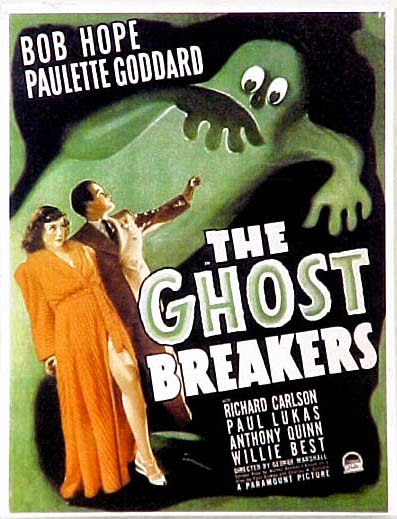
The Ghost Breakers (1940)
When Bob Hope and Paulette Goddard made a hit comic murder mystery with “The Cat and the Canary” in 1939, it was inevitable that they would be paired again. This time, Hope is Larry Lawrence, a radio broadcaster who thinks he has accidently killed a gangster. Believing he’s a marked man, he pairs up with Mary Carter (Goddard), a young lady who recently inherited her family's ancestral home on a remote island off of Cuba. Not only is the old mansion reputedly haunted, but there is supposedly buried treasure on the property as well. So Larry and Mary take off from New York City and head for the island.

As Larry and Mary hunt for the treasure, they have to contend with ghosts, zombies, and gangsters. This is a very 1940 movie: You get a Hollywood view of a pre-Castro Cuba, Hope’s brand of self-effacing comedy, funny support from Willie Best as his valet Alex, and a cute romantic foil in Goddard, who gets to wear some snappy fashions. As with any Hope comedy of the 1940s, the tongue is firmly in cheek, the energy level is high, and the laughs plenty. It’s fun to see him turn the haunted house clichés on their head.

The cinematography is atmospheric and makes the most of the haunted house plotline, using shadows to underscore the frightening situations that Larry finds himself in, yet giving Hope a chance to play his comically cowardly character to the hilt. The supporting cast includes stalwart character actors like Paul Lukas, Richard Carlson, and a very young Anthony Quinn in two roles. (And there’s even a character called “Mother Zombie.”)


Hold That Ghost (1941) 
The comedy of Abbott and Costello is probably a matter of taste, but for my money they are a timeless comic duo. Although their shtick is rooted in their time, I think it transcends the decade because it’s so basic (and funny). In this, one of their best, gas station attendants Chuck (Bud Abbott) and Ferdie (Lou Costello) inherit a haunted tavern from a gangster named Moose Matsen. Little do the boys know that Moose has hidden money in the tavern. 

Chuck and Ferdie take a bus to see their property, but when the bus arrives and everyone gets off, the driver takes off and leaves them there. Furthermore, one of the bus passengers, Charlie Smith, (Marc Lawrence) is a gangster out to get Moose’s dough.

As Chuck, Ferdie, and the other passengers investigate the creepy old tavern, it soon becomes apparent that it’s haunted. When the corpse of Charlie turns up, everyone knows things are getting strange. Pretty soon ghosts start appearing and things begin moving on their own. There is a particularly hilarious bit with poor Ferdie being scared witless by a moving candle.

To add to the fun of the classic routines of Abbot and Costello, you get the loud, brassy Joan Davis as Camille Brewster, a professional radio “screamer” who gets to ply her talent on more than one occasion. (She’s hilarious.) For love interest, you get Evelyn Ankers as Norma. Universal Studios billed Ankers as “The Scream Queen” in many a straight horror film of the era, so between her and Davis, you get a lot of screaming in this movie. Proving it’s 1941, there’s an appearance by The Andrews Sisters, while fans of The Three Stooges will enjoy seeing Shemp Howard as a soda jerk.


Topper Returns (1941)
This is the third installment of the famous “Topper” series, which started in 1937 with Cary Grant and Constance Bennett as a ghostly couple who help their fuddy-duddy friend Cosmo Topper (Roland Young) enjoy life. That hit film was followed, sans Grant, in 1939’s “Topper Takes a Trip.”

While both are clever movies that boast fun special effects and smooth performances from their stars, the surprise is that the last installment is, in my opinion, the most entertaining and funny. In this story, friends Gail Richards (Joan Blondell) and Ann Carrington (Carole Landis) arrive at Landis’s father’s old mansion, which Cosmo and his wife are also visiting.

But someone is out to knock off Ann. When the girls switch rooms before hitting the hay on their first night, the killer offs Gail by mistake. Of course, only Topper can see her ghost, so he has to help her solve the mystery of who killed her and to protect Ann, the killer’s real target.

The thin plot is aided by a very fast pace, impressive special effects (like a dress walking without a body), funny dialogue and situations, and a breezy performance by Joan Blondell, who always seemed like she was having a grand time. She’s aided by a supporting cast that includes Dennis O'Keefe as a reporter with eyes on Ann; Patsy Kelly as the smart-mouthed maid; Billie Burke as dizzy Mrs. Topper; and Donald MacBride as the befuddled police sergeant trying to find out what the heck is going on in this madcap household. They all have their moments.

But it’s Eddie 'Rochester' Anderson as Ann’s chauffeur who steals every single scene he’s in; he has some of the best lines, and his watery fight with a slippery seal is a side-splitting scream.


Ghost Catchers (1944)
Where Abbot and Costello are still a familiar comedy team, Ole Olsen and Chic Johnson are not well known today. Starting as a top vaudeville team, their success continued in the 1930s and ‘40s on the radio and, occasionally, in movies. Their brand of comedy was manic, chaotic, interactive and seemingly unrehearsed, a precursor to today’s improvisational comedy style. In the less than a dozen movies they made together, we see how vaudevillian humor shaped American comedy.

In this farcical film, old-style Southern Colonel Breckinridge Martshall and his daughters have taken up residence in—you guess it—a haunted house. When the ghosts start doing scary stuff, the girls enlist the help of nightclub owners Olsen and Johnson, who agree to help rid the house of the pesky spirits.

That’s pretty much the plot, and it’s just an excuse for the zany antics of the guys. The goings-on are raw, loud, and funny in a way that you just don’t see nowadays. It’s a bit of a mystery to me why this comic team fell off the radar, especially when their output is so self-contained in just a handful of movies.

Character actors who round out the cast include the gravel-voiced Andy Devine, Lon Chaney Jr. (who spoofs his own reputation in many fright films of the ‘40s), and the hilariously befuddled Walter Catlett as the Colonel.


The Canterville Ghost (1944)
This is probably the biggest-budgeted title in this list, starring a true A-list actor of the time, Charles Laughton. Known for heavy dramatic roles, this film gives him a chance to have a little fun as Sir Simon de Canterville.

The film opens with Sir Simon in 17th century England. Faced with a duel, he cowardly runs away and hides. His ashamed father holes him up in his room in the Canterville Castle and condemns Sir Simon to die alone and remain a ghost only until one of his descendants proves his bravery.

Fast forward to 1944, and there’s a war on; Cuffy Williams (Robert Young) is an American soldier stationed with his troop in the old castle, which is now owned by cute six-year-old Lady Jessica de Canterville (Margaret O'Brien). She discovers that Cuffy is a Canterville by his birthmark.

Cuffy can see and interact with Sir Simon. When Simon explains his situation, he claims that it is the Canterville way to be cowardly, but Cuffy scoffs. However, when the time comes to prove his mettle during a raid in France, Cuffy chokes. It appears that he indeed takes after Sir Simon.

To add insult to injury, when an unexploded parachute mine threatens his platoon, Cuffy is crippled with fear yet again; but when Lady Jessica accidentally activates the mine, Cuffy seizes his moment and explodes the mine away from his brothers in arms.

Having broken the Canterville curse of cowardice, Cuffy has set Sir Simon free. 

Based loosely on an Oscar Wilde short story, “The Canterville Ghost” is more subtle (less slapsticky) than the other titles in this list, and therefore more charmingly amusing than chaotically comical. Being a brilliant actor, Laughton manages to imbue his larger-than-life character with pathos, most touchingly realized when Sir Simon learns his curse has been lifted.

This blog post comes just in time for Halloween. So if you’re used to blood-and-guts scares, try something different and get a few laughs along with your chills. These five films are a gentler incarnation of fright, but they probably won’t give you nightmares.

Other recommended titles in this genre:
  • “The Smiling Ghost” (1941, which co-starred Willie Best, again as the hero’s valet)
  • “The Boogie Man Will Get You” (1942, which gave Boris Karloff, the original Frankenstein’s monster, a chance to poke fun at his creepy image)
  • “One Body Too Many” (1944, starring Jack Haley, the Tin Man in “The Wizard of Oz,” as a hapless salesman)
  • Abbott and Costello’s “The Time of Their Lives” (1946, in which it’s Lou who’s the ghost)