Tuesday, November 18, 2014

Thanks For Your Support

I was talking movies with my friend Amir the other day, and the name Celeste Holm came up. We both agreed that she had a unique personality, and she featured prominently in some true classics, including a film that tackled the then-taboo subject of anti-Semitism. Never the star of the picture, Holm nevertheless made an impression in a number of other supporting parts in several notable films of the post-war years.

Thinking of her solid support led me to writing this post. I gave some thought to the many, many supporting players during Hollywood’s Golden Age, who were usually cast in second lead roles. It was hard, but I narrowed it down to four very different people—two men and two women—who, to my eye, always elevated the material by their sheer presence, personality, and professionalism.

Let’s start with Miss Holm, and go from there.

Celeste Holm
After making a splash in the original Broadway production of “Oklahoma!” Hollywood beckoned Holm, a new talent who brought a refreshing naturalness to the screen and enhanced a number of high-profile pictures in the late 1940s and early 1950s. She is a distinctly post-war figure in films.

Like many of the women who came before her, she could do comedy as well as drama. In each role she played, though, her wit is prevalent. With Celeste Holm, you always got a strong and smart, yet feminine and refined, woman who was quick with a well-delivered barb. Here are a few of her best films:

“Gentleman's Agreement” (1947) – Gregory Peck plays Philip Green, a writer who is pretending to be Jewish to reveal anti-Semitism in America. He learns how prevalent it is and finds it, along with hypocrisy, in surprising places. After appearing in a couple musicals that leveraged her singing ability and comic ability, “Gentleman’s Agreement” gave Holm an opportunity to show off her subtle dramatic chops; she lends strong support as Philip’s friend Anne (who may or may not be in love with him). Her character is a stylish, warm-hearted sophisticate who is the moral center of the film. It co-stars John Garfield, Dorothy Maguire, and the marvelous Anne Revere as Peck’s mother.

“A Letter to Three Wives” (1948) – Holm is the narrator of this film, a wry satire on post-war suburban mores. As the unseen Addie Ross, the film unfolds as Holm reads the letter that Addie has sent to her three dearest friends. In it, she explains that she has left town with one of their husbands. The balance of the movie focuses on the stories of the three women (Jeanne Crain, Linda Darnell, and Ann Sothern) and the relationships with their husbands (Jeffrey Lynn, Paul Douglas, and Kirk Douglas, respectively). Who’s hubby did Addie steal? You’ll have to watch to find out. It’s a smart film, and Holm sets the tone at the outset with her dry, droll, cunning narration.

“Come to the Stable” (1949) – In a change of pace, Holm and Loretta Young play French nuns who come to a small New England town to build a children's hospital. They are surprised to find that some of the townsfolk are against their plan—including representatives of the Catholic church. It’s a very sweet and gentle film, and Holm is suitably tender in it, demonstrating that she did not always have to be the brittle, witty sophisticate. That said, she does have a funny scene where she plays a mean game of tennis—and aims to win.

"All About Eve” (1950) – In perhaps her best-known film and role, Holm is Karen Richards, the best friend of Bette Davis’s Margot Channing, a famous, temperamental stage star. Where Davis’s performance is florid and funny, Holm’s Karen is more sedate; she’s the serene leveler to Margot’s self-indulgence, the calm in the midst of a stormy story that’s full of larger-than-life theater types. Everyone gets to chew the scenery at one point or another, including Anne Baxter, George Sanders, Gary Merrill (later Davis’s husband), and even Marilyn Monroe in an early role. Not to be missed.

After 1950, Holm spent most of her career in the new medium of television, including her own sitcom. She made sporadic film appearances, including a few musicals that took advantage of her excellent voice, all the way up to 2012, when she died at age 96.

Jack Carson
Jack Carson is a type of man you just don’t see anymore. More often than not, he played an affable, back-slapping type. He was a guy’s guy with a self-deprecating laugh and a comically skeptical sidelong glance to punctuate a line, whether his or someone else’s.

Small parts in nearly 50 A- and B-grade films from 1937 through the early ‘40s had him in lots of small or unbilled blue collar roles as cab drivers, truck drivers, and cops, with occasional bigger parts that revealed his comic timing. He lent light support in comedies starring such big names as Bette Davis, James Cagney, Ginger Rogers, Edward G. Robinson, Carole Lombard, and others. 

After WWII, he landed at Warner Brothers, where he became one of their most dependable players. Although not all from Warners, here are a few of his notable titles:

“Love Crazy” (1941) – This is one of my favorite comedies, in which William Powell pretends to be insane so he can get back into his wife’s (Myrna Loy) good graces. The movie is fast-paced slapstick, and has some very funny moments. It’s one of the many early roles that stereotyped Carson as a guileless dunderhead. Here, he’s Loy’s neighbor (“The name’s Willoughby, Ward Willoughby”) who has designs on her even as Powell tries to make amends. Carson’s patented double-takes and quizzical looks make every scene he’s in a riot.

“The Hard Way” (1943) – Helen Chernin (Ida Lupino) pushes her younger sister Katherine (Joan Leslie) into show business as a way of getting out of their dingy steel town. As part of that plan, she urges Katharine to marry Albert Runkel (Carson), an old-school Vaudevillian who’s down on his luck. Katharine eventually becomes a Broadway star, but Helen’s conniving takes its toll on everyone, especially herself. This is prime grade-A Warner Brothers melodrama, and Carson gets a chance to add some shading to his shabby song-and-dance man.

Carson made three movies with Doris Day
and 11 with Dennis Morgan (at right).
“Mildred Pierce” (1945) – In this classic film noir, Joan Crawford is the show as a poor woman who becomes a successful restaurateur, all the while trying to keep her spoiled daughter (Ann Blyth) from ruining both their lives. As Wally Fay, Carson is a would-be real estate mogul who nurses an ongoing crush on her. He leverages his established persona as a cuddly bear, but while he's amusingly lecherous, he makes his character heartfelt as well, the kind of guy a hard-working gal needs as a friend. Carson also gets some terrific dialogue, especially his banter with Eve Arden (who deserves her own blog post).

“Cat on a Hot Tin Roof” (1958) – By the late ‘50s, Hollywood had changed, as had filmgoers’ tastes. Now Carson could turn his affable-guy persona into someone less than sympathetic. In this somewhat watered-down film adaptation of the play by Tennessee Williams, Carson is Gooper Pollitt, the scheming older brother of the tortured Brick (Paul Newman). Carson’s is an excellent performance in a stellar ensemble that also includes Elizabeth Taylor, Burl Ives, Judith Anderson, and the venal Madeleine Sherwood. Carson’s work here is worth seeing as a counterpoint to his persona of the previous decade.

During his heyday of the mid-to-late 1940s, audiences preferred Jack Carson in light fare, and he always delivered. While most of the many comedies and musicals he made after WWII are forgotten today, he kept busy all the way up to 1963, when he succumbed to cancer. By then, most of his male contemporaries—Bogart, Gable, Cooper, and many others—were already gone, thus confirming that the Golden Age of Hollywood was over.

Mary Astor
Mary Astor started out as a leading lady in silent films and successfully made the transition to talking pictures. Throughout the 1930s, she played mostly high society ladies in sophisticated parlor comedies, romances, and even an adventure film or two. But she really came into her own in the 1940s by playing a range of fascinating characters that were quite distinct.

Astor could be sweet or sour, or sometimes both. She could be tender and pathetic, arch and austere, haughty or heroic, hilarious or nefarious. In fact, her most famous role was Brigid O’Shaughnessy, the film noir femme fatale archetype, in 1941’s “The Maltese Falcon.” But just three years later, there she was being Judy Garland’s understanding mother in “Meet Me in Saint Louis.”

Whether playing a villainous vixen or a Midwestern mother, she did it all with subtle shading. Where, for example, Jack Carson delivered a reliable sameness, Astor's work varied remarkably, especially from the mid-1930s to the late 1940s. Here are a few of the titles in a long film career that stand out:

“Dodsworth” (1936) – This film was the subject of my first blog post at “In a Movie Place.” It’s a great movie, a potent slice of the American character of the mid-1930s. While Walter Huston, as rich industrialist Sam Dodsworth, is the film’s namesake, I think the heart of the movie belongs to Astor. As Edith Cortright, a slightly jaded divorcee who falls for the unhappily married Sam, she is the grounded one among a cast of characters whose heads are in the clouds. Her natural and affecting performance feels real, especially when compared to Ruth Chatterton, who, as Dodsworth’s pretentious, philandering wife, is comparatively tinny and artificial. Astor owns the heartbreaking finale.

“The Great Lie” (1941) – Five years after her sympathetic portrayal in “Dodsworth,” Astor turns the bitch factor up 100 notches as a temperamental, selfish concert pianist who gets pregnant by a married man and has to flee to the desert to have the baby in seclusion. (Only in a movie from the 1940s would this be the case.) Despite its absurdity, the film is grandly entertaining; Astor manages to steals the show from, of all people, Bette Davis, who graciously underplays, leaving the histrionics to Astor.

“The Palm Beach Story” (1942) – Just when her career seemed to be tilting to the heavy, what with all the drama and film noir treachery, Astor lightens up considerably in this hilarious comedy. She’s Princess Centimillia, the flighty, flirty sister of zillionaire J.D. Hackensacker III (Rudy Vallee), who’s after Gerry Jeffers (Claudette Colbert), who’s being chased by her husband Tom (Joel McCrae), on whom the Princess has set her eyes. Everyone in this fast-paced movie is funny, but as a clueless society dame, Astor shows a deliciously unbridled side.

“Act of Violence” (1949) – Toward the end of the ‘40s, Astor’s career was on the wane. But in the same year she played the sweet Marmee in MGM’s adaptation of “Little Women,” she played a small but pivotal role as a hard-luck prostitute in this relatively unknown but outstanding film noir. In it, she comes to the aid of Frank Enley (Van Heflin), a war veteran whose small town life with his unassuming wife (Janet Leigh) is disrupted when Joe Parkson (Robert Ryan), a soldier in Frank’s regiment during the war, comes back to get revenge. Astor’s character, known only as Pat, is pathetic and delusional, but she imbues her with a touching dignity that ends up being the thing you remember most about the film.

Like many of her contemporaries, Astor spent the 1950s and early ‘60s in television, with the occasional small movie role. She had a single, but important, scene in her last film, 1964's “Hush, Hush Sweet Charlotte” (which re-teamed her with Bette Davis, although they have no scenes together). After an eventful private life that included a sex scandal, three divorces, the death of her first husband by plane crash, alcoholism, heart problems, and more, she died in 1987 at age 81.

This quote from Astor humorously indicates that she knew full-well the trajectory of her career: “There are five stages in the life of an actor: Who's Mary Astor? Get me Mary Astor. Get me a Mary Astor type. Get me a young Mary Astor. Who's Mary Astor?"

Melvyn Douglas
Melvyn Douglas could not be more different than Jack Carson, in build, looks, style, or temperament; but like Carson, you knew what you were getting when he appeared in a film. During the 1930s and ‘40s, Douglas was always the urbane gentleman. His was a popular archetype at that time, accented by the pencil-thin mustache shared by many of his contemporaries (think William Powell, Ronald Colman, John Barrymore, Adolphe Menjou, etc.)

Looking back on his career, Douglas appeared in many genuinely unimportant movies, studio fare typical of the time. The studios leveraged his good looks but usually demanded little from him. He did get the occasional change of pace with two classic comedies that stand out: “Theodora Goes Wild” (1936) and “Ninotchka” (1939), unique in that they also gave his co-stars, Irene Dunne and Greta Garbo, the chance to loosen up and be funny for a change.

What's most interesting about Douglas is that his work during the studio era actually led up to his greatest roles in the 1960s. Here are a few key roles in his career, spanning 30 years:

“A Woman's Face” (1941) – Although you might dismiss this movie as standard soapy MGM fare, it’s actually quite well-made and includes one of Joan Crawford’s best performances. She plays Anna Holm, a criminal with a horribly disfigured face (and a really bad attitude). When Dr. Gustaf Segert (Douglas) operates to fix her disfigurement, she must choose whether to continue her life of crime or to turn over a new leaf. I include this movie here because it’s one of the better films in which Douglas appeared at this time. He acquits himself convincingly opposite Joan. (Side note: The same year, Douglas starred in another “face” movie, “Two-Faced Woman”; it was "Ninotchka" co-star Greta Garbo’s last movie.)

“Mr. Blandings Builds His Dream House” (1948) – This cute, homey little comedy could only have been made in the years after WWII. It concerns Jim and Muriel Blandings (Cary Grant and Myrna Loy), a city couple who buy a fixer-upper in the country and are presented with one calamity after another. (Kind of like Tom Hanks and Shelley Long in “The Money Pit,” but better.) Douglas is their avuncular friend Bill Cole, who wryly observes (and narrates) the zany goings-on as the Blandings try to find suburban bliss. This film demonstrates Douglas’s pivot into character parts, which would define the remainder of his career.

Again, it seems that the first two decades of Douglas's film career seemed only to set the stage for the greatness to come. In the 1960s, he re-established himself as a character actor of the first order. His performances in the next two films sometimes seem like they came from a different man altogether.

As the grizzled rancher Homer
Bannon in "Hud."
“Hud” (1963) – Hud Bannon (Paul Newman) is the good-for-nothing son of a cattle rancher in Texas whose integrity is as solid as the earth he stands on. The two are constantly at odds, as Hud takes advantage of everyone. Seeing this film, you’d think Douglas was much older; it’s hard to believe that less than 25 years earlier, he was the debonair sophisticate romancing Garbo and Crawford. In Hud, he is grizzled, and his eyes seem to have seen everything. His performance is staggering in its quiet power. Patricia Neal and Brandon de Wilde round out a perfect cast, but maybe the real star is the austere black-and-white cinematography, which evokes a specific time and place, yet gives the film a timeless feel.

“I Never Sang for My Father” (1970) – Gene Hackman plays Gene Garrisson, a professor who wants to move from New York to California, but feels beholden to his aging, widowed father (Douglas). This film is a devastating character study of two very different men—different in generation, in temperament, in attitudes—and it captures the ambivalence of its time very well. The look and tone of the film indicates a societal and generational shift. Douglas’s performance is magnificent; he captures the sadness, bitterness, and bewilderment of getting old and feeling as though one is no longer in control. Hackman excels in an early role as the dutiful but noncommittal son.

Douglas continued acting in television and an interesting variety of films all the way up to 1981, when he was cast in the spooky “Ghost Story” with several other old-timers, including Fred Astaire, Douglas Fairbanks, Jr., and John Houseman. After a very long career, he died later that year.

Making your mark as a supporting actor was difficult to do in the 1930s and ‘40s, when there were so many strong leading actors who often stole the show. Supporting actors, however, often have a chance to really spread their wings much later in their careers, after they've broken out of their initial "box," as these four actors demonstrate. 

As different as they are, I feel that Celeste Holm, Jack Carson, Mary Astor, and Melvyn Douglas are excellent, underrated performers who often made a bigger impression than the people they were supporting, and their work deserves a closer look. Each claims a legacy of indelible screen work that seems fresh and compelling so many years later.

Thursday, October 16, 2014

Five Ghost Stories with Comic Flair

In the movies, a “ghost story” means something different today than it did in the old days. With an emphasis on psychology, the occult, and mysticism; advances in special effects; and few limitations on what can be graphically depicted, it’s no surprise that movies about otherworldly spirits are much more aggressive in tone today than in the past.

But let’s skip all the mumbo-jumbo and overblown digital effects and go back to the early 1940s. This was a time before people got their thrills from watching teenagers get their throats slashed by a guy wearing a mask or their faces chewed off by marauding zombies. The early ‘40s was a comparatively innocent time, when movie-makers had a flair for coupling fright with fun and cleverly using camera tricks to imply ghostly doings.

Many of the comic spookfests made in the ‘40s were low-budget affairs featuring lowbrow comedy. But there were a few that successfully joined a simple old-dark-house formula with the comic style of their respective stars. Add to that the playful sleight-of-hand effects typical of the time, and you get creepily comic fun that makes your skin crawl without relying on blood and guts.

Here are five black-and-white comic scarefests that are emblematic of the ghost story of the early 1940s: Full of hapless heroes, cute co-stars, slamming doors, spooky apparitions, objects moving on their own, weird housekeepers, witless gangsters, and comical cops.


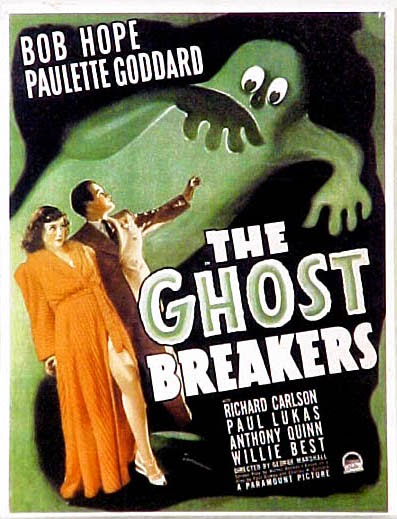
The Ghost Breakers (1940)
When Bob Hope and Paulette Goddard made a hit comic murder mystery with “The Cat and the Canary” in 1939, it was inevitable that they would be paired again. This time, Hope is Larry Lawrence, a radio broadcaster who thinks he has accidently killed a gangster. Believing he’s a marked man, he pairs up with Mary Carter (Goddard), a young lady who recently inherited her family's ancestral home on a remote island off of Cuba. Not only is the old mansion reputedly haunted, but there is supposedly buried treasure on the property as well. So Larry and Mary take off from New York City and head for the island.

As Larry and Mary hunt for the treasure, they have to contend with ghosts, zombies, and gangsters. This is a very 1940 movie: You get a Hollywood view of a pre-Castro Cuba, Hope’s brand of self-effacing comedy, funny support from Willie Best as his valet Alex, and a cute romantic foil in Goddard, who gets to wear some snappy fashions. As with any Hope comedy of the 1940s, the tongue is firmly in cheek, the energy level is high, and the laughs plenty. It’s fun to see him turn the haunted house clichés on their head.

The cinematography is atmospheric and makes the most of the haunted house plotline, using shadows to underscore the frightening situations that Larry finds himself in, yet giving Hope a chance to play his comically cowardly character to the hilt. The supporting cast includes stalwart character actors like Paul Lukas, Richard Carlson, and a very young Anthony Quinn in two roles. (And there’s even a character called “Mother Zombie.”)


Hold That Ghost (1941) 
The comedy of Abbott and Costello is probably a matter of taste, but for my money they are a timeless comic duo. Although their shtick is rooted in their time, I think it transcends the decade because it’s so basic (and funny). In this, one of their best, gas station attendants Chuck (Bud Abbott) and Ferdie (Lou Costello) inherit a haunted tavern from a gangster named Moose Matsen. Little do the boys know that Moose has hidden money in the tavern. 

Chuck and Ferdie take a bus to see their property, but when the bus arrives and everyone gets off, the driver takes off and leaves them there. Furthermore, one of the bus passengers, Charlie Smith, (Marc Lawrence) is a gangster out to get Moose’s dough.

As Chuck, Ferdie, and the other passengers investigate the creepy old tavern, it soon becomes apparent that it’s haunted. When the corpse of Charlie turns up, everyone knows things are getting strange. Pretty soon ghosts start appearing and things begin moving on their own. There is a particularly hilarious bit with poor Ferdie being scared witless by a moving candle.

To add to the fun of the classic routines of Abbot and Costello, you get the loud, brassy Joan Davis as Camille Brewster, a professional radio “screamer” who gets to ply her talent on more than one occasion. (She’s hilarious.) For love interest, you get Evelyn Ankers as Norma. Universal Studios billed Ankers as “The Scream Queen” in many a straight horror film of the era, so between her and Davis, you get a lot of screaming in this movie. Proving it’s 1941, there’s an appearance by The Andrews Sisters, while fans of The Three Stooges will enjoy seeing Shemp Howard as a soda jerk.


Topper Returns (1941)
This is the third installment of the famous “Topper” series, which started in 1937 with Cary Grant and Constance Bennett as a ghostly couple who help their fuddy-duddy friend Cosmo Topper (Roland Young) enjoy life. That hit film was followed, sans Grant, in 1939’s “Topper Takes a Trip.”

While both are clever movies that boast fun special effects and smooth performances from their stars, the surprise is that the last installment is, in my opinion, the most entertaining and funny. In this story, friends Gail Richards (Joan Blondell) and Ann Carrington (Carole Landis) arrive at Landis’s father’s old mansion, which Cosmo and his wife are also visiting.

But someone is out to knock off Ann. When the girls switch rooms before hitting the hay on their first night, the killer offs Gail by mistake. Of course, only Topper can see her ghost, so he has to help her solve the mystery of who killed her and to protect Ann, the killer’s real target.

The thin plot is aided by a very fast pace, impressive special effects (like a dress walking without a body), funny dialogue and situations, and a breezy performance by Joan Blondell, who always seemed like she was having a grand time. She’s aided by a supporting cast that includes Dennis O'Keefe as a reporter with eyes on Ann; Patsy Kelly as the smart-mouthed maid; Billie Burke as dizzy Mrs. Topper; and Donald MacBride as the befuddled police sergeant trying to find out what the heck is going on in this madcap household. They all have their moments.

But it’s Eddie 'Rochester' Anderson as Ann’s chauffeur who steals every single scene he’s in; he has some of the best lines, and his watery fight with a slippery seal is a side-splitting scream.


Ghost Catchers (1944)
Where Abbot and Costello are still a familiar comedy team, Ole Olsen and Chic Johnson are not well known today. Starting as a top vaudeville team, their success continued in the 1930s and ‘40s on the radio and, occasionally, in movies. Their brand of comedy was manic, chaotic, interactive and seemingly unrehearsed, a precursor to today’s improvisational comedy style. In the less than a dozen movies they made together, we see how vaudevillian humor shaped American comedy.

In this farcical film, old-style Southern Colonel Breckinridge Martshall and his daughters have taken up residence in—you guess it—a haunted house. When the ghosts start doing scary stuff, the girls enlist the help of nightclub owners Olsen and Johnson, who agree to help rid the house of the pesky spirits.

That’s pretty much the plot, and it’s just an excuse for the zany antics of the guys. The goings-on are raw, loud, and funny in a way that you just don’t see nowadays. It’s a bit of a mystery to me why this comic team fell off the radar, especially when their output is so self-contained in just a handful of movies.

Character actors who round out the cast include the gravel-voiced Andy Devine, Lon Chaney Jr. (who spoofs his own reputation in many fright films of the ‘40s), and the hilariously befuddled Walter Catlett as the Colonel.


The Canterville Ghost (1944)
This is probably the biggest-budgeted title in this list, starring a true A-list actor of the time, Charles Laughton. Known for heavy dramatic roles, this film gives him a chance to have a little fun as Sir Simon de Canterville.

The film opens with Sir Simon in 17th century England. Faced with a duel, he cowardly runs away and hides. His ashamed father holes him up in his room in the Canterville Castle and condemns Sir Simon to die alone and remain a ghost only until one of his descendants proves his bravery.

Fast forward to 1944, and there’s a war on; Cuffy Williams (Robert Young) is an American soldier stationed with his troop in the old castle, which is now owned by cute six-year-old Lady Jessica de Canterville (Margaret O'Brien). She discovers that Cuffy is a Canterville by his birthmark.

Cuffy can see and interact with Sir Simon. When Simon explains his situation, he claims that it is the Canterville way to be cowardly, but Cuffy scoffs. However, when the time comes to prove his mettle during a raid in France, Cuffy chokes. It appears that he indeed takes after Sir Simon.

To add insult to injury, when an unexploded parachute mine threatens his platoon, Cuffy is crippled with fear yet again; but when Lady Jessica accidentally activates the mine, Cuffy seizes his moment and explodes the mine away from his brothers in arms.

Having broken the Canterville curse of cowardice, Cuffy has set Sir Simon free. 

Based loosely on an Oscar Wilde short story, “The Canterville Ghost” is more subtle (less slapsticky) than the other titles in this list, and therefore more charmingly amusing than chaotically comical. Being a brilliant actor, Laughton manages to imbue his larger-than-life character with pathos, most touchingly realized when Sir Simon learns his curse has been lifted.

This blog post comes just in time for Halloween. So if you’re used to blood-and-guts scares, try something different and get a few laughs along with your chills. These five films are a gentler incarnation of fright, but they probably won’t give you nightmares.

Other recommended titles in this genre:
  • “The Smiling Ghost” (1941, which co-starred Willie Best, again as the hero’s valet)
  • “The Boogie Man Will Get You” (1942, which gave Boris Karloff, the original Frankenstein’s monster, a chance to poke fun at his creepy image)
  • “One Body Too Many” (1944, starring Jack Haley, the Tin Man in “The Wizard of Oz,” as a hapless salesman)
  • Abbott and Costello’s “The Time of Their Lives” (1946, in which it’s Lou who’s the ghost)

Tuesday, September 23, 2014

Five Fifties Films that Comment on Their Era

Most people today equate the 1950s with a “time of innocence.” That cliché seems to oversimplify the period. I’m not sure how innocent it was living in a world poised for nuclear destruction at almost any moment.

When it comes to the movies, Hollywood was in the fight of its life against its biggest competitor, television. So movies were dominated by new and bigger ways to tell a story, including wide-screen formats like Cinemascope and VistaVision, 3D, and other gimmicks.

Movies featured a range of new female types, including such blonde dichotomies as Marilyn Monroe and Doris Day. New Method actors like Brando, Newman, and James Dean joined the ranks of established male stars, such as Gable and Grant. There was the quick rise of teen culture, with its rock ‘n roll, hot rods, and untamed youth. Monster movies dominated the drive-in. Broadway musicals were adapted in big productions. And westerns glorified the American West in full Technicolor.

If nostalgia illustrates a more naive cinema in the 1950s, it’s worth taking a look at a few titles from that decade that seem to exceed expectations. These are films that surprised me because they seemed to strongly comment on the era: Its morality, values, gender expectations; the idea that an old guard will soon give way to a younger, more explosive generation; and the underlying sense of doom and disappointment hovering over a post-war, nuclear age.


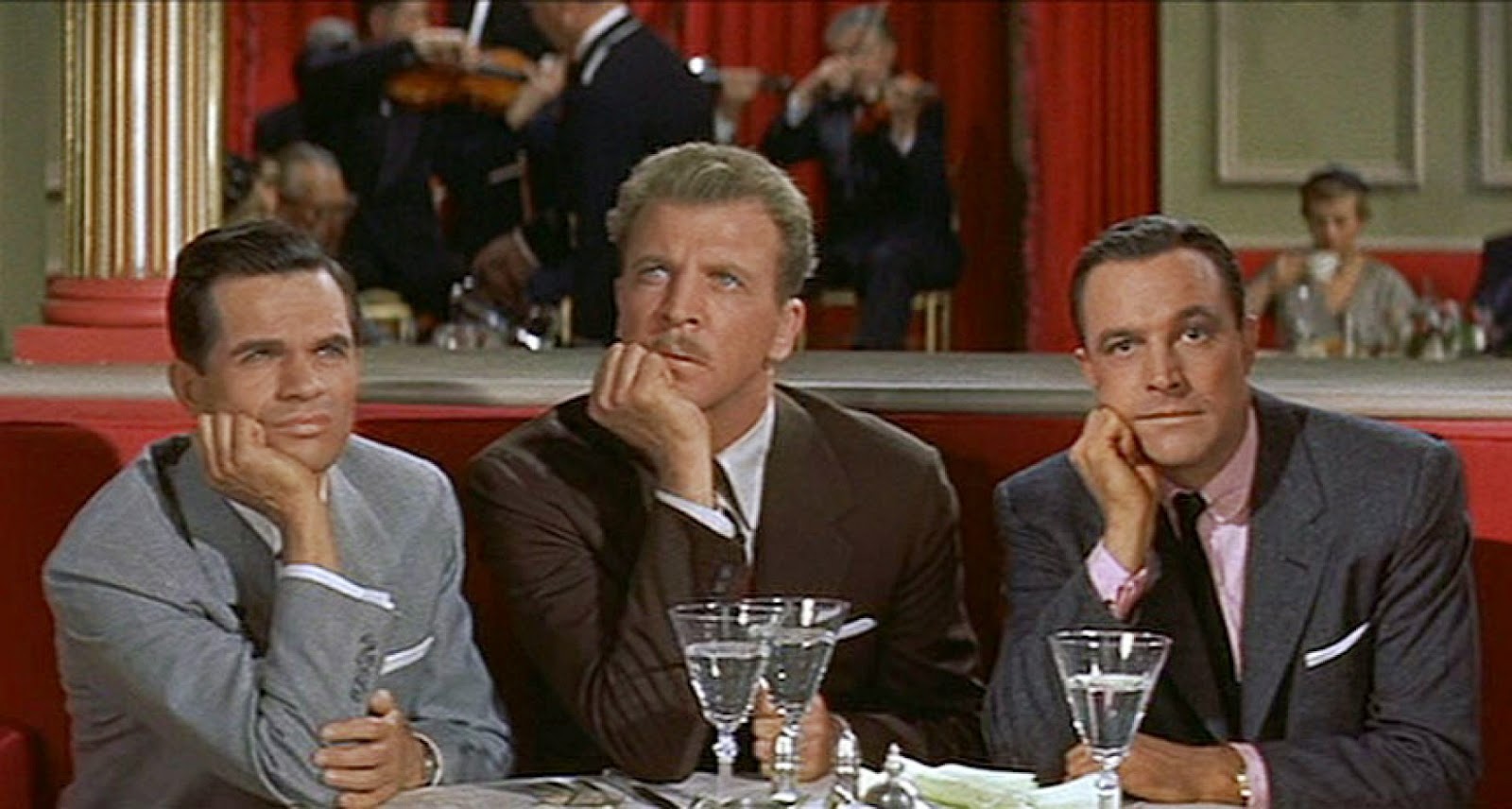
"It's Always Fair Weather" (1955): The Unhappy Musical

They shouldn't have come.
Maybe it makes sense that the first film in our list is a bright, energetic song-and-dance fest. But there’s a reason “It’s Always Fair Weather” is known as ‘the unhappy musical.’

The plot involves three soldiers—Ted Riley (Gene Kelly), Doug Hallerton (Dan Dailey) and Angie Valentine (Michael Kidd)—who served in the Army together. When the war ends in 1945, they celebrate at a little dive bar in New York City, vowing to remain friends forever and meet up again in exactly ten years. Their joy in being home is demonstrated in a fantastic number that has them tap-dancing with metal garbage can lids on their feet. (It’s amazing.)

Their loving departure is followed by a montage sequence that encapsulates the ensuing decade. It reveals that none of their lives turned out quite as they had hoped. Ted had dreams of becoming a lawyer, but now he’s a boxing promoter with a gambling problem; Doug wanted to be a painter, but now works in a thankless advertising job; Angie had wanted to become a chef, but now runs a hamburger stand.

When the ten-year anniversary arrives, they grudgingly meet up. And it turns out that not only do they have nothing in common anymore, they also don’t even like each other. Since this is a big Hollywood musical, their contempt is comically rendered in the song “I Shouldn’t Have Come.”

So how do we keep these guys together for the sake of the story? At the restaurant where they’ve met, Doug sees his coworker Jackie Leighton (Cyd Charisse), who gets the idea to have the men reunite on a popular TV show. Nothing says sentimental like reuniting three war veterans in front of a national audience. A guaranteed ratings grab!

That’s where the satire comes in. We meet the show’s host, Madeline Bradville (Dolores Gray), who embodies everything unctuous about television in the 1950s. Gray is iconic of the decade, born to wear her hair in the style of the day and dressed to the nines in definitive fifties fashions. I can’t envision her in any other decade. She is perfect to play the superficially silken host of a typical fifties variety show, her over-powdered persona fitting the role like a glove. But she’s in on the joke, which is what makes the scenes in the TV studio work so well from a satirical perspective.

Cyd Charisse was an amazingly gorgeous dancer and capable comedienne. When Jackie falls for Ted, she gets to do her showcase number set in a boxing gym (“Baby You Knock Me Out”). It’s not to be missed.

Actually, there are no throwaway routines in “It’s Always Fair Weather.” You get to see Gene Kelly dancing in roller skates (it’s genius), and Dan Daily’s musings on being a cog in the wheel of the ad agency (“Situation-Wise”) is a bitter comment on the work world of the 1950s.

When Ted refuses to fix a boxing match, gangsters are in hot pursuit, which culminates in a melee on Madeline’s live show. This brings the guys back together, albeit briefly, and helps re-set their lives to a certain degree. At the conclusion of the film, they part ways—more amicably this time—but it’s clear they’ll never see each other again.

And that’s the key to the movie: cynicism. At a time when musicals were typically bright and sunny, “It’s Always Fair Weather” attempts to tell a story of disappointment through song and dance. Even the title is a play on words. These guys were really just fair-weather friends, at a point in their lives when they needed each other. And is it really always fair weather? Nope, it’s not.

Although not a commercial success at the time, the movie stands as an excellent example of the Hollywood musical. And it shows that a film can be hugely entertaining and gently funny and still be sharply satirical. The director, Stanley Donen, had a light touch, but a bit of an edge too. Perhaps television was an easy target in 1955, but how many mainstream, thought-provoking—yet light-hearted—satires on any aspect of American culture have there been in recent years?

“Patterns” (1956): Big Business, '50s Style

A movie poster for "Patterns."
Fans of “Mad Men” will find the movie “Patterns” especially interesting. Despite not being set in the world of advertising (the world of Dan Dailey's character in "It's Always Fair Weather," discussed above), it's a vivid window into the world of business during the 1950s. (I realize the “Mad Men” series is set in the 1960s, but close enough.)

Fred Staples (Van Heflin) has recently joined Ramsey & Co., an industrial powerhouse headed by Walter Ramsey (Everett Sloane). Ramsey is grooming Fred to replace Bill Briggs (Ed Begley), an older executive in whom Ramsey has lost faith.

Bill is a good man who cares about his employees, but Ramsey is a ruthless executive whose primary care is making money at any cost. He repeatedly humiliates Bill in meetings and discounts his ideas. He takes every opportunity to publicly paint Bill as outmoded, out of step, incompetent, and unworthy of his current position.

Fred sees what Ramsey is doing to Bill; although Fred is ambitious and wants a greater position at the company, he encourages Bill to fight back. Ramsey, meanwhile, feels that Fred is a fool to care too deeply about the man he has been hired to replace.

After a final heated boardroom confrontation, Bill suffers a heart attack and dies. As a result, Fred realizes that he cannot in good conscience work for a man who cares nothing about his human capital. But before Fred can quit, Ramsey persuades him to stay on. Fred seizes the opportunity to sweeten the deal (a larger salary, stock options); but he lays out in no uncertain terms that he will work diligently to one day oust Ramsey. To this challenge, the venal Ramsey merely smiles.

This is a tough, intelligent little film. It takes place almost exclusively in either the boardroom or various offices at Ramsey & Co. There are a few scenes at Fred’s home and elsewhere, but the direction is very tight. This means that the dialogue is the key to the film’s power. It has a briskly intelligent script by Rod Serling (creator of “The Twilight Zone”), based on his teleplay, which was first broadcast in 1955. The film provides a historically important window on how business operated in the 1950s. In viewing it, though, one wonders how much has really changed, aside from clothing styles and office equipment.

The men—all excellent—are really the show here, which makes sense for a movie about big business in the 1950s. But fine and underrated actresses are also featured: Beatrice Straight is outstanding as Fred’s wife. Buffs should watch her in “Patterns” and then follow it up with her similar role, albeit 20 years later, in 1976’s “Network” as William Holden’s put-upon wife. (For that one, she won an Oscar.) Elizabeth Wilson, as Bill’s faithful former secretary who now reluctantly reports to Fred, is one of the best character actresses out there—and she’s still working at 93.

Since I always have to find a connection between one blog post and another, I must point out that a quick glimpse of the filmography of the late Lauren Bacall (the subject of my last post) shows that she has an uncredited role in “Patterns” as ‘Lobby lady near elevators.’ I’d love to know how she ended up in that bit part.


"Indiscreet" (1958): A Romantic Comedy for Grown-Ups

Ingrid Bergman in her fabulous art-filled apartment.
The only straight comedy in this post is Stanley Donen’s “Indiscreet,” based on a play by Norman Krasna (who adapted his screenplay). Donen also co-directed “It’s Always Fair Weather,” but this time he brings down the tone for a sophisticated romance.

Anna Kalman (Ingrid Bergman) is a stage actress living in London. Returning from a vacation in Spain, during which she met a man who didn’t quite live up to her expectations, she laments to her sister Margaret (Phyllis Calvert) that she will never fall in love. But just as suddenly, she meets Philip Adams (Cary Grant), a charming financier who is a work acquaintance of her brother-in-law Alfred (Cecil Parker).

Sparks fly between Anna and Philip, yet he makes it clear that he is married. Even after they fall for each other, Philip insists that, whatever happens between them, he cannot leave his wife. Their romance continues despite his marital situation, and Anna finds herself falling deeper, which creates conflict in her mind.

Then, Anna learns that Philip has been keeping something from her. (I won’t say what it is.) On a night out with Philip, Margaret, and Alfred, Anna regards Philip with muted contempt, knowing he has been lying. In a climactic comic scene in her apartment, she tries to corner him, only to discover his innocent reasons for not being entirely forthcoming.

I won’t tell you how it ends, but suffice to say that it ends on a beautiful note. The joy of this film is the subtlety of Grant and Bergman. They are both warm, witty, and urbane, and have excellent chemistry. (They worked together only once before, 12 years earlier, in Alfred Hitchcock’s “Notorious,” quite a different type of movie.)

From its opening credits with a close-up of lush roses, to its soaring music score, to the sets (especially Bergman’s art-filled London flat), to its performers, I find “Indiscreet” refreshingly grown-up, not given to the coy conventions of most films about adult relationships of the 1950s. Watching the film’s nimble direction by Donen underscores how incapable modern filmmakers seem to be of making light comedies in which adults behave like adults.

While I thoroughly enjoy this classy production on its own merits, I include it here because it seems to represent the ‘old guard’ I mentioned in the post’s introduction. Here we have a 54-year-old Cary Grant and a 43-year-old Ingrid Bergman playing two established people engaged in a romance.

But their days as relevant movie stars were numbered, for as we know in hindsight, the next decade represented the explosive younger generation, whose ideas about sexuality and morality, manners and behavior would change considerably. Grant and Bergman would soon represent the parents of that youthful generation. Ten years later, this film would have been viewed as completely square.

"Bonjour Tristesse" (1958): Le Teenager Dangereuse

One of several movie posters for "Bonjour Tristesse."
I include this next film because it picks up from “Indiscreet,” in that the focus is a teenager. Jean Seberg would quickly move on from this, her second feature, to become an icon of youthful rebellion in Jean-Luc Godard's 1960 ‘New Wave’ film “Breathless.”

“Bonjour Tristesse” opens in black and white, showing Raymond (David Niven) and his bored daughter Cécile (Seberg) lolling in a Paris nightclub, commenting on the passersby and basically idling their time. It then moves to their villa on the French Riviera, now in glorious color. (The location photography is stunning, by the way.)

Raymond is a careless playboy who spoils Cécile; they live an idyllic, decadent existence, and the daughter follows in the father’s footsteps, which he encourages. When Anne Larson (Deborah Kerr), an old friend of Raymond’s late wife, arrives at the villa, it sets off Cecile’s jealousies and fears that her carefree life will be disrupted.

Anne is an elegant, refined woman who, despite her affection for Raymond, is woefully out of her depth. He is a cad, and his affection for her is strictly superficial; he is unwilling to change from being the lothario he freely admits that he is. (In fact, he has a young mistress who basically lives with him at the villa.)

In her childish impulse to keep things as they were, Cecile aims to sabotage the relationship between Raymond and Anne. The older woman indulges Cecile’s immaturity up to a point, but circumstances lead her to flee the house in her car—which leads to a tragedy that changes Raymond and Cecile irrevocably, not necessarily for the better.

Otto Preminger’s output as a director was spotty, but I find “Bonjour Tristesse” to be an effective film that examines how similar the thought processes are for two immature, selfish people: One a middle-aged male; the other a young girl on the brink of womanhood. Raymond and Cecile are basically parasites who feed off and encourage the other’s self-indulgence.

The film closes in black and white again, this time fixing on Seberg in close-up as she considers what she has done. Her sorrow is palpable, yet the viewer wonders what, if anything, she has truly learned.


"The World, the Flesh, and the Devil" (1959): Not the End, but the Beginning

One of the striking scenes of a bereft New York City.
This post-apocalyptic drama opens after a cave-in, which has trapped miner Ralph Burton (Harry Belafonte) while inspecting a mine. He hears rescuers above, but eventually the sound of drilling stops completely. When he understands that help is not coming, Ralph digs himself out on his own. When he reaches land above, he finds abandoned buildings and vehicles, but no people.

Ralph does, however, find newspapers that herald the end of the world. It appears that an unnamed nation has used lethal radioactive isotopes to kill off humanity.

Completely alone, Ralph makes it to New York City, but still finds no one. The early scenes are especially gripping, as you see this single man grappling with a city devoid of life. The photography is stunning, with outstanding visuals that underscore Ralph’s loneliness. You feel his despair as he walks along empty streets, abandoned cars at odd angles, newspapers rustling by his feet. Long shots of cavernous streets littered with debris indicate a civilized world that has come to a complete halt.

Taking up residence in a swanky apartment, Ralph restores power so he has light, and can even play records on a hi-fi. (It’s 1959, remember.) Becoming increasingly lonely, he finds two mannequins from a clothing store and puts them in his apartment so he has some company. But fake people are almost worse than no people at all.

Ralph eventually takes out his lonely frustration on the male mannequin, pushing it off the apartment’s balcony. As it hits the ground, Ralph hears a woman’s scream from the street below. There’s someone else alive in the city!

The woman is Sarah Crandall (Inger Stevens), who is white. Starved for companionship, the two live separately but spend every moment together. Sarah eventually falls in love with Ralph. But he is the product of a segregated society, and the conventions of his time force him to maintain a distance from her.

When the two discover a moving boat on the water, they find a very sick Benson Thacker (Mel Ferrer) at the wheel. Sarah and Ralph help Ben get well, but the dynamic has shifted; Ben falls for Sarah, and Ralph becomes his rival.

The situation degenerates and Ralph and Ben commit to fighting for the affection of Sarah. In a climactic standoff, shots are fired as they roam the empty city. But when Ralph comes upon the United Nations, he reads an inscription from the Book of Isaiah 2:4: “They shall beat their swords into plowshares. And their spears into pruning hooks. Nation shall not lift up sword against nation. Neither shall they learn war any more.”

Realizing the absurdity of this hunt to the death, Ralph confronts Ben and drops his gun. In turn, Ben cannot kill Ralph. They separate, but when Sarah appears, she takes each of their hands—one black, one white—in hers.

The movie isn’t a complete success, but it’s intelligently made and well-played by the three leads. It’s worth including in this post because it had something definite to say about two touchy subjects in 1959: Race relations and the threat of atomic annihilation.

In these ways, “The World, The Flesh, and The Devil” is a pivotal film that was ahead of its time. It raises important existential questions in an atomic world, setting a tone that would be realized as the 1960s proceeded: The rise of the civil rights movement, acceptance of interracial marriage, the anti-war movement during the protracted Vietnam conflict, and the anti-nukes protests that would gather momentum in the 1970s.

Conclusion

The 1950s has been called a simpler, more naive time in America, and perhaps to a degree that is true. Certainly by comparison to today, the morals, values, fashions, and standards of behavior have changed quite a bit. 

But no era is really simple; there were many threats looming over this nation during that decade, some of which were the result of the world war that had been fought and won the decade before. With that victory came prosperity, which spurred new values (not all of them positive), as well as new threats. The decade's basic conservativsm paved the way for the upheaval of the decade that followed. In the five films discussed here, I’ve tried to capture the nascent forces that eventually changed our culture, for better or for worse.

Thursday, August 21, 2014

Lauren Bacall: A Designing Woman

One of my all-time favorite people, Lauren Bacall, passed away at age 89 on August 12. In the flurry of articles about her personality, her films, her marriage to Humphrey Bogart, and countless other variations on her career, I read a piece by writer Neal Gabler. In it, he stated, “She hadn’t been so much a star as she was a flare.”

I never thought about her as anything but a star, in the truest sense of the word. In fact, she managed to maintain her star status for seven decades, which says a lot, since audiences tend to forget famous, pseudo-famous, and infamous people quickly. She was a woman who was identified with Hollywood’s “golden age,” yet worked steadily literally to the end.

Perhaps in terms of initial fame, Gabler’s statement is true. When she hit the scene, she was unlike anything anyone had yet seen on the screen. Sleek, silky, and sexy, she was perfect for a genre of melodrama that later gained respectability as ‘film noir.’ She had the right look and the right tone for stories of intrigue in shimmering black and white.

It’s arguable that Bacall’s best period was the 1940s, but that was just the groundwork. In 1944, she came out of nowhere and made a smashing debut opposite Bogart in “To Have and Have Not.” She would marry him shortly after, and between 1946 and 1948, they would make three more films together. (She made a fifth film without him in 1945, which was a noted flop.)

But even after the film noir style faded in the 1950s, Bacall had moved on to other things. She showed a wry humor in a couple comedies in the '50s, which she had never been called upon to do in the previous decade. She also tried out other genres, including adventure, psychological drama, pure soap opera, and even a western. Meanwhile, she made some notable television appearances, including an adaptation of Noel Coward's "Blithe Spirit"—co-starring with Coward himself—and reuniting with Bogart in “The Petrified Forest,” an adaptation of the play—and subsequent movie—that made him famous 20 years earlier. Interestingly, Bacall’s role was originally played by her film idol, Bette Davis.

The lady did it all, and she did it with a lack of pretense. Let’s take a look at some essential titles that encompass classic Bacall during her heyday:

Bacall in the 1940s
When she hit the scene, Bacall didn’t have much acting experience. She had been a model, and her brand of sultry sexiness was new. Maybe it was the eyes, the tilt of her head, the shoulder-length hair, or the way she held her body; but it was nothing that had been seen up to that point. Looking at her still images now, there is an undeniable dynamism; the images seem to move. Film stardom in a certain kind of black-and-white cinema seemed to be her destiny.


“To Have and Have Not” (1944)
This was Bacall’s first film, and it made an indelible impression. A story of wartime intrigue, it capitalized on Bogart’s image as the ambivalent hero, which he created in “Casablanca.” This time, the story is set in Martinique, with Bogart as Harry Morgan, an expatriate American who agrees to help transport a Free French Resistance leader and his wife. But the story is mere backdrop to the fireworks set off between Bogart and Bacall, as 'Slim' Browning, an itinerant lounge singer. The atmosphere is classic ‘40s Warner Bros., all dark shadows and stark light, with rich detail and set pieces. Bacall has some electric moments with Bogart, and even sings one song. Justin Timberlake sang about bringing sexy back, but watching her in this movie, you may think it never left.


“The Big Sleep” (1946)
Although confusing as heck, “The Big Sleep” contains all of the visual and tonal tropes we have come to expect from film noir. You’ve got the hardened gumshoe Philip Marlowe (Bogart again) getting caught up in a convoluted story involving a wealthy family with secrets, including the eldest daughter, the mysterious Vivian Rutledge (Bacall). There are various characters, none of whom can be trusted; and story angles that lead to dead ends while opening yet another door. Above all, “The Big Sleep” is about the atmosphere and the dialogue; the most entertaining bits are between Bogart and Bacall, of course.  She is sultry and funny, and never sexier or more glamorous than she is here. Worth noting: '50s star Dorothy Malone has a small role as a bookshop clerk in a single scene opposite Bogart. She would pop back into Bacall's filmic periphery ten years later. Read on.


“Dark Passage” (1947)
It’s Bacall with Bogart again, in another black-and-white noir, this time with a twist: Bogart is Vincent Parry, an escaped convict who has plastic surgery to change his appearance; the first 20 minutes or so of the film are told entirely from his point of view, so we don’t see him as Bogart until his “new” face is revealed. To hide from the police, he is taken in by Irene Jansen (Bacall), an artist with a fabulous modern apartment. (I had to point that out.) She willingly conceals him from everyone, including the police and a nosey society friend played by Agnes Moorehead, who is marvelously monstrous. (She has the best exit scene ever. Must see.) This revenge tale is exciting and features some neat on-location San Francisco photography. Bacall is a softer version of herself in “To Have and Have Not” and “The Big Sleep,” but she comes off as sharp, smart, and sympathetic here. For film noir fans, this is essential viewing.


Just like Bogie and Bacall
“Key Largo” (1948)
In this final teaming of Bogart and Bacall, the setting changes from exotic or urban to the Florida keys. Here, the war-weary Frank McCloud (Bogart) visits a hotel on Key Largo to honor a friend who died during the war. He meets the friend’s widow, Nora Temple (Bacall) and her father (Lionel Barrymore). As a hurricane whips up, the three find themselves prisoner of a notorious gangster (Edward G. Robinson) and his drunken, pathetic moll (Claire Trevor). The story involves Bogart’s increasing resolve to take action despite his revulsion toward violence after everything he lived through—and lost—during the war. There is an exciting climax, and the undeniable chemistry between Bogart and Bacall that have made each of their films together classics. It may be this, their final film, that cemented their legend. (Remember that pop song in the '80s? "Sailin' away to Key Largo...")


One of my favorite pics.
Bacall in the 1950s
By the time the '40s ended, Bacall was already backsliding a bit, making way for a different kind of female movie star. While she was still relevant, the new decade would be dominated by sexy broads like Marilyn Monroe; squeaky-clean girls next door like Doris Day or June Allyson (all of whom would eventually be her co-stars); elegant ice queens like Grace Kelly or Deborah Kerr; and impish gamines like Audrey Hepburn or Leslie Caron. By contrast, Bacall’s image during this decade had a crisp, down-to-earth edge. She adapted herself to fit the post-war world.


“Young Man with a Horn” (1950)
In this serious drama, Bacall was second-billed after Kirk Douglas, but the real female star was third-billed Doris Day, who had made only a couple of musical comedies up to this point. The movie documents the rise and fall of brash trumpeter Rick Martin (Douglas). Bacall’s Amy North is the rich girl who causes him trouble, paving the way for Jo Jordan (Day) to save him from alcoholism and self-destruction. The film is often cited for an early portrayal of lesbianism, which is implied between Amy and another young woman. It sure does tick off Rick in one confrontation scene, although it’s tame by today’s standards. This is a transitional film for Bacall, as she's moving out of noir films and into a new decade. She was no longer the sultry heroine, and she had to find new ground.


“How to Marry a Millionaire” (1953)
This time around, Bacall is part of a triumvirate of filmic females, and she is sort of sandwiched between co-stars Marilyn Monroe (then a rising star) and Betty Grable (then a descending star). They represent three types of '50s femininity: There’s earthy, flirty Loco Dempsey (Grable); sexy but dingy Pola Debevoise (Monroe); and no-nonsense, practical Schatze Page (Bacall). It's a fun, bright Technicolor comedy rooted in its time, but still hugely entertaining because it's so well-crafted and written, about three models in New York City who are trying to snare a millionaire husband. Bacall has some of the best lines. To whit:


Loco: "I wouldn't mind marrying a Vanderbilt."
Pola: "Or Mr. Cadillac."
Schatze: "No such person. I checked."

Also: “I've always liked older men... Look at that old fellow, what's-his-name, in ‘The African Queen.’ Absolutely crazy about him." (In this little Hollywood in-joke, she's referring to husband Bogart.)

Looked good in slacks
“Written on the Wind” (1956)
Bacall had her greatest successes in the 1950s when she was part of an ensemble, and in “Written on the Wind,” she’s part of a good one. This is a big-budget Douglas Sirk production, which promises high drama and a glossy Technicolor sheen. Spoiled oil heir Kyle Hadley (Robert Stack) marries Lucy Moore (Bacall), who is secretly loved by Kyle’s best friend Mitch Wayne (Rock Hudson). The Hadleys are a troubled bunch, as Kyle is an alcoholic, and his volatile sister Marylee (Dorothy Malone) is a nymphomaniac who’s got her addled eyes on Mitch. Yes, this is pure soap opera, but it’s almost operatic in its crescendos and climax. Bacall’s characterization is suitably muted, although she was never given to overdone histrionics. The showiest part belongs to Malone, whom I mentioned had a small part as a nameless bookstore clerk in the “The Big Sleep” ten years before. (By the 1950s, Malone was a top-tier star in the brittle blonde mode, somewhere between M. Monroe and Grace Kelly.)

“Designing Woman” (1957)
This was the first film Bacall made after Bogart’s death from cancer. Perhaps she chose a chic comedy as a way to distract herself. It’s typical battle-of-the-sexes in the Hepburn-Tracy mold (she and Hepburn were bosom pals). Mike Hagen (Gregory Peck) is a sports writer and Marilla Brown (Bacall) is a fashion designer. True to comic form, their styles clash. The storyline has Mike trying to prove that a mobster is fixing boxing matches, which causes some complications with Marilla. The film is enjoyable, but I never thought Peck was very good at comedy. He tries his best, but he is a little stiff. (I would have loved to have seen Cary Grant in this role.) Bacall, by contrast, is marvelously loose and alive. It’s this film that seems to have solidified her enduring persona as a chic, sophisticated woman of the world who not only dressed well, but was also smart, funny, and wise. “Designing Woman” was directed by the great Vincente Minnelli (Liza’s papa) and co-stars the furiously funny Dolores Gray, so you really can’t go wrong.


Looking fresh.
By the 1960s, Bacall’s leading lady stardom had already slipped. She made sporadic film appearances, but in 1970 starred in a huge hit on stage in “Applause,” a musical adaptation of “All About Eve” (which, side note, also starred her idol Bette Davis). She was entering yet another phase of her career: An established film star of Hollywood's "Golden Age" and a respected stage personality. She could have retired, saying she’d done it all; but she had three books to write yet, she had more stage work to perform, she had yet to become a sought-after character actress, and she had a lot of filmmaking lore to share in countless fascinating interviews.

It's worth noting that she was married to Bogart for only 13 years; but her career didn't stop when he died. In fact, her richest work was to come, and she continued at it for another six decades. Over the last 25 years alone, Bacall did more than most actresses of her generation: Voiceover work in cartoons (Scooby Doo, Madeleine, Family Guy); a small role in a Stephen King adaptation (“Misery”); playing Barbra Streisand’s mother, which won her an Oscar (“The Mirror Has Two Faces”); co-starring in two weird, arty Lars von Trier films (“Dogville” and “Manderlay”); lending her presence to many (often inferior) pictures... and who can forget those Fancy Feast commercials? All the while she preserved the Bogart memory, and may be largely responsible for ensuring his important, iconic status over the last 50+ years.

Lauren Bacall has been an enduring presence all these years and has always stood for something worth admiring: Strength of character, integrity, a no-nonsense approach to life. She was a dame with class and dignity, a gritty and glamorous personality who commanded attention. She never disappeared, until she finally did—after living a long and damn useful life.

The writer I cited earlier in this post contended that, “In the end, she was a glamorous figure from another, darker era…and the wife of Humphrey Bogart.” I contend that she must have struggled with loving and keeping alive Bogart's memory, yet trying since his death to come out from his shadow to establish herself without him. I’d say that, in the end, she did just fine.

Here's a neat little tribute via Turner Classic Movies.